
Getting into Sea Kayaking as a Whitewater Kayaker
Paddling comes in many flavors, and at Portland Paddle we love them all. But making the jump from one type of paddling to another isn’t always straightforward, and the move between sea kayaking and whitewater kayaking can be especially tricky. In this post we’re sharing some tips on making the switch. First, though, here’s a conversation on the topic with Dan Cox, a seasoned sea kayak guides and experienced whitewater paddler.
Conversation with Dan Cox, Sea Kayaker & Whitewater Kayaker
(Interview has been edited for length and clarity).
Q: How long have you been a paddler?
Dan: 25 Years
Q: Were you a whitewater or a sea kayaker first?
Dan: Whitewater
Q: How and why did you get started sea kayaking?
A: I can’t exactly remember exactly but it was a combo of just wanting to do a long expedition that my WW kayak was not suitable for and also have a fun way to explore the large amounts of water in NC that did not have whitewater on it.
Q: What’s a favorite place to go whitewater paddling? What about sea kayaking?
Dan: The favorite river would be Wilson Creek and for sea kayaking my favorite spot is Shackleford Banks, both in NC where I grew up.
Q: What are some existing skills that whitewater kayakers will be able to transfer to sea kayaking?
Dan: The paddle strokes and body mechanics are all the same so it’s generally easier for whitewater paddlers to go sea kayak than for the reverse in my opinion, just because there is so much that goes into reading the water and controlling your boat on a whitewater river.
Q: What are some key new skills whitewater kayakers will need to learn?
Dan: The most important thing a whitewater kayaker will need to learn is seamanship skills like navigation, tides, weather, rules of the road. Next would be to practice rescuing a sea kayak and also figuring out how to edge a sea kayak effectively since these will both be different from what you would do in a whitewater boat. Last, towing is different since in WW you are conditioned to never (rarely, if ever) attach yourself to another kayak with a rope but sea kayakers do that all the time, just because the environmental hazards are different.
Q: Equipment is often big on people’s minds when starting a new activity. What new gear should whitewater kayakers expanding their horizons pick up, and what stuff will they be able to keep using?

Dan Cox, sea kayak guide
Dan: Most of the gear crosses well but the safety equipment you take when sea kayaking is different. So get a Radio, Bilge Pump, Paddle Float, and Tow Belt at a minimum – and know how to use them effectively.
Q: What boats and paddles do you currently own?
Dan: For sea kayaks, Valley Aqaunat HV and Wilderness Systems Zephyr 15.5. For whitewater, a Jackson Kayak Superstar. Paddles… I have a lot. Werner Corryvrecken Bent Shaft, Werner Ikilos Bent Shaft, 2 Greenland Paddles, Werner Player bent shaft, and Werner player Straightshaft. Plus some paddleboards, paddles, and surfboards.
Q: If someone already has some paddling experience from another discipline, they might be tempted to “just figure it out”. Why might it still be a good idea to work with an instructor or guide?
Dan: An instructor is like getting a learning rocket boost. They will identify the areas you can improve and also help you improve. Don’t be the person who holds their paddle upside down for 10 years.
Q: As people start to gain more experience in sea kayaking they often start to get into “roughwater” paddling. Can you explain what sea kayakers mean by “roughwater”?
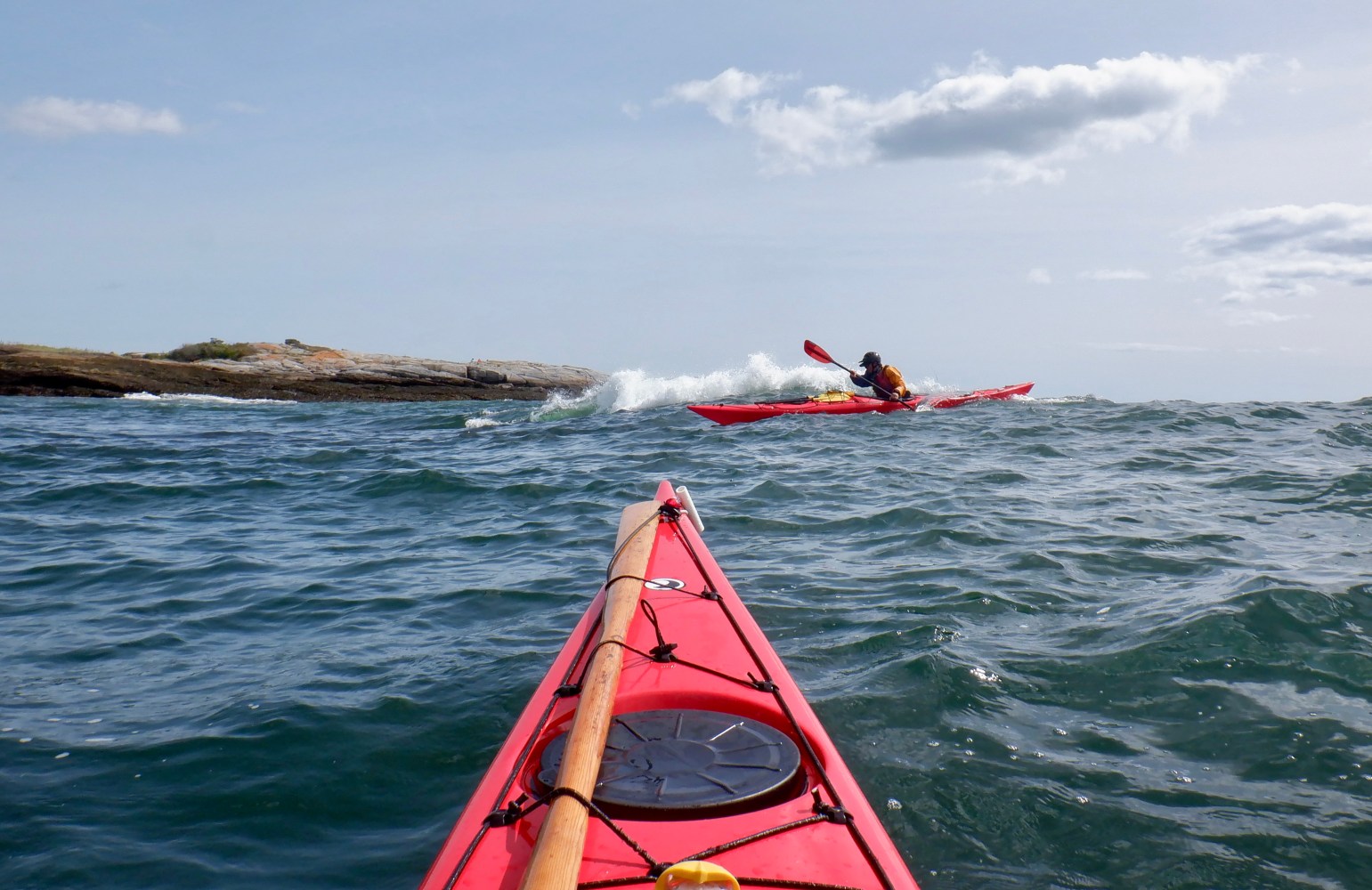
Dan: Roughwater paddling generally means taking your sea kayak into breaking waves and trying to have fun (for me this means being in control of my boat). These waves could be formed by the ocean bottom (beach break – think traditional surf), rocks (rock gardening), or currents (tidal rapids).
Q: What’s a favorite memory or story of yours from sea kayaking in Maine?
Dan: Well, I have a thing for puffins and I wanted to paddle out to Eastern Egg Rock to see them. The first attempt was part of a multiday Muscongus Bay trip and I ended up having to abort since a major thunderstorm was on its way. I was only a couple miles away but ended up instead sitting on Allen Island in a lightning position pondering my life choices. The second time I left Round Pond in Pea Soup fog. Paddling for a few hours in near zero visibility I almost aborted. Luckily, my friend encouraged me to keep going saying “It will be sunny on the way back.” Sure enough, we made it to the island, the bright sun came out, and were surrounded by Puffins all around us. Epic.
Thanks to Dan for sharing his knowledge! Read on for more information on the differences between whitewater and sea kayaks, and some ideas for how to get started growing your paddling skills!
Boat Design: Similarities and Differences
Sea kayaks and whitewater kayaks are both meant to handle varied conditions and rough water, but they do so in different environments and in different ways. Here are some key similarities and differences.
| Sea Kayaks | Whitewater Kayaks | |
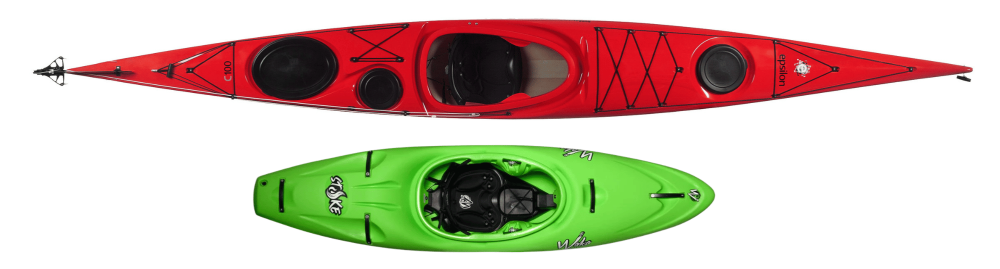
| Length | Sea kayaks are long (14-18 feet typically) for better tracking and speed. They also have a rudder or skeg to help with tracking straight. | Whitewater kayaks are shorter for more maneuverability (5-9 feet typically). |
| Shape | Sea kayaks are narrower with a distinct “v-hull” and pointed bow to “slice” through the water. | Whitewater kayaks are wider, usually with a planing or rounded hull, for better maneuverability and capacity to “punch” through river features. |
| Additional Features | Sea kayaks have deck hatches and sealed bulkheads for flotation and gear storage. They also have deck lines, deck bungees, and bow and stern grab toggles. | Whitewater kayaks have no exposed cordage and fixed grab handles. With no sealed bulkheads, paddlers may use float bags to help with water displacement. |
Can you get one boat to do it all?
Not really. Some “hybrid” boats designed for whitewater racing, rock gardening, big river touring (like the Grand Canyon), or mixed touring (sections of whitewater followed by sections of flat) will combine features from different categories. They often look like an extra long whitewater creek boat, somewhere between 9 and 14 feet in length, with a skeg and/or hatches and bulkheads. Boats which fall into this hybrid world include Dagger’s Stratos and Katana, Jackson’s Karma Traverse, and Pyranha’s 12R, Hammer, and Fusion II. While these hybrid boats might be tempting to purchase as one boat to rule them all, you’ll often find they are much slower and have less gear capacity than full sea kayaks, and are not as playful on small whitewater rivers. Paddlers growing into a new discipline are usually better off getting a design specific to their goals. Both categories of kayaks have a large range of variety in their designs, including in flat, round, or v hull shapes, edge or chine “softness,” amount of rocker, cockpit design, and more. The only way to know what you like is to try out a whole bunch!
Are you a whitewater kayaker interested in expeditions or ocean paddling?
Here are six ways to get started:
- Brush up on your navigation skills, a critical factor in a safe and enjoyable trip on the ocean
- Join our two part Intro to Sea Kayaking courses, or our Intro to Sea Kayaking weekend workshop
- Take our Expedition Skills weekend workshop to dive deep into route selection, efficient long distance paddling, and campcraft skills on Maine’s remote islands
- Learn about the origins of kayaking and a new type of freestyle (did you know there are trick rolls and rolling competitions?) with our traditional greenland skills class
- Learn how to rescue yourself and others in the marine environment with a rescue class
- Try out surfing a beach break! Our Sea Kayak Surf Clinic and Roughwater Skills Weekend Workshop will teach you about long boat handling, reading a surf forecast, and assessing the break when you get there
Are you a sea kayaker interested in whitewater and roughwater kayaking?
Here are six ways to get started:
- Get your rescues, rolls, and braces dialed.
- Take a course in rock gardening, sea kayak surfing, or our comprehensive Roughwater Weekend Workshop
- Take a course on sea kayaking in tidal currents, like the ones offered by our partners at Pinniped Kayak
- Take an intro to whitewater rivers course, like those offered by Zoar Outdoors or Northeast Whitewater
- Try out paddling some class II by entering the longboats division of a NECKRA or MACKRO downriver race, or push yourself in a variety of conditions with our very own East End Race Series.
- Pinniped Kayak also offers a “whitewater for sea kayakers” course just for you!